US Airstrikes In Nigeria: An African Perspective
Background on Airstrikes and US Engagement in Africa
On 25 December 2025, the United States (US) conducted precision airstrikes against Islamic State-linked targets in Sokoto State, northwestern Nigeria. The operation, executed by US Africa Command (AFRICOM) and authorised by President Donald Trump, targeted militant camps near the border with Niger. Initial assessments reported multiple militant deaths, with no verified civilian casualties or damage to non-target sites. The strikes were launched from a US naval platform in the Gulf of Guinea, utilising munitions such as Tomahawk cruise missiles. This marked the first confirmed US kinetic military action on Nigerian soil, a significant shift from Washington’s previous non-kinetic support, such as intelligence sharing and training.
The Nigerian government confirmed the strikes as a coordinated effort, emphasising sovereignty and rejecting any religious framing. Foreign Minister Yusuf Tuggar described it as part of broader international security cooperation, with decisions on future actions remaining under joint leadership. President Trump, however, framed the action ideologically, portraying it as a response to attacks on Christians and warning of more to come. This narrative contrasted with Nigeria’s stance that extremist violence affects both Muslims and Christians, rooted more in regional instability than sectarianism.
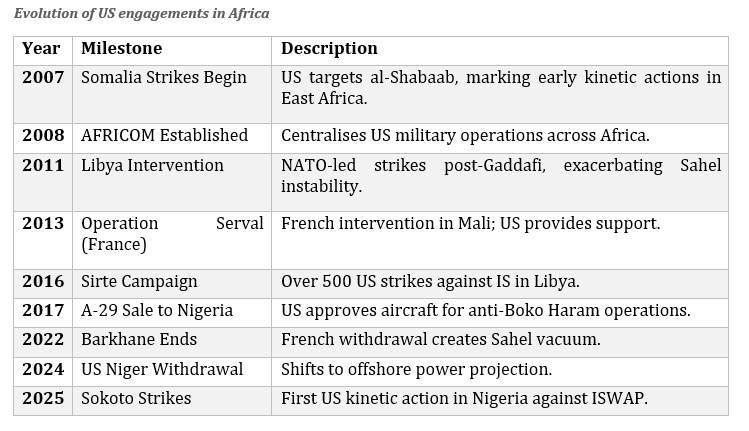
US military involvement in Africa has evolved since the post-9/11 era, when counterterrorism became a primary focus. Established in 2008, AFRICOM has conducted approximately 1,000 strikes across the continent, including over 500 in Libya’s Sirte in 2016 and an escalation to more than 100 in Somalia in 2025 alone. In Nigeria, engagement historically centred on non-kinetic aid against Boko Haram and Islamic State West Africa Province (ISWAP), such as the 2017 sale of A-29 Super Tucano aircraft and training in civilian harm mitigation, despite restrictions under the Leahy Law due to human rights concerns.
Milestones include French-led operations like Serval (2013) and Barkhane (2014-2022) in the Sahel, which created a security vacuum after withdrawals by 2024. This vacuum prompted US pivots, including withdrawals from Niger in 2025 and increased offshore projections. The Sokoto strikes echo this pattern, targeting IS affiliates amid jihadist spillover from the Sahel, where groups like IS-Sahel and al-Qaeda exploit instability post the 2011 Libyan crisis.
US National Security Strategy and Africa
The 2025 US National Security Strategy (NSS), released in November, reframes Africa’s role from aid recipient to strategic asset in great power competition, particularly with China and Russia. It shifts from development-led diplomacy to transactional models emphasising trade, investment, and selective security partnerships. Africa is positioned as a competitive arena, with priorities including harnessing abundant natural resources, fostering mutually beneficial trade, and transitioning from foreign aid to investment paradigms.
The NSS advocates partnering with “capable, reliable states” committed to market openness, while avoiding long-term US presence or commitments. It highlights opportunities in energy and critical minerals, such as US-backed nuclear energy, liquefied natural gas, and liquid petroleum gas developments to generate profits and counter competitors. Counterterrorism remains reactive, focusing on containing Islamist threats without nation-building, as seen in the Nigeria strikes. Conflicts like those in the Democratic Republic of the Congo or Sudan are flagged for negotiation, with amendments to frameworks like the Africa Growth and Opportunity Act proposed to bolster investment.
This strategy aligns with broader US goals of protecting core interests, including securing supply chains and promoting stability amid geopolitical rivalries. However, it risks overlooking African-led initiatives, prioritising US economic gains over holistic development.
Impacts and African Perspectives
The airstrikes degraded Islamic State command structures and support nodes in Sokoto, including overlaps with local groups like Lakurawa. However, tactical gains may prove short-lived without ground operations, risking a “balloon effect” where militants disperse into peripheral areas or rival networks like Jama’at Nusrat al-Islam wal-Muslimin (JNIM). JNIM’s southward expansion, evidenced by its October 2025 attack in Kwara State, could benefit from this disruption, exploiting governance gaps and criminal-bandit ecosystems.
No civilian casualties were officially reported, but regional experts question the targeting, noting IS affiliates’ traditional focus in northeast Borno rather than northwest Sokoto. Public reactions in Nigeria were mixed: supportive in Christian communities and urban areas as overdue aid, but divided among religious leaders, with some warning against militarised solutions. President Trump’s religious framing angered figures like Sheikh Ahmad Gumi— a prominent Nigerian Islamic scholar, former military officer, and influential cleric known for his involvement in negotiating with bandits in Nigeria’s Northwest—who condemned it as polarising and called for partnerships with “neutral” countries like China or Türkiye.
From a continental viewpoint, the African Union (AU) and Economic Community of West African States (ECOWAS) issued no formal statements, implicitly aligning with Nigeria’s collaborative narrative amid jihadist threats. The Alliance of Sahel States (AES)—Mali, Burkina Faso, Niger—responded with border mobilisations, fearing militant displacement and viewing it as Western unilateralism, bolstering ties with Russia.
These reactions underscore African priorities: countering extremism while preserving autonomy. The strikes sharpened the ECOWAS-AES divide, hindering intelligence sharing and cross-border operations, creating seams for militants. Economically, markets remained calm, reflecting confidence in Nigeria’s reforms, but inland regions face heightened risks from banditry and kidnappings, disrupting trade and agriculture. This could impede the African Continental Free Trade Area (AfCFTA), exacerbating fragmentation.
Future Expectations and Africa’s Path Forward
The December 2025 US airstrikes in Nigeria signal a potential escalation in Washington’s engagement with the continent, driven by the priorities outlined in the November 2025 US National Security Strategy (NSS). This document reframes Africa not as a recipient of aid but as a strategic arena for trade, investment, and selective security partnerships, while explicitly avoiding long-term military commitments. From an African perspective, this shift presents both opportunities for economic collaboration and risks of deepened dependency, geopolitical tensions, and overlooked local priorities.
Potential Military and Security Engagements
The Sokoto strikes mark a pivot toward offshore power projection from the Gulf of Guinea, following US withdrawals from Sahel bases like Niger in 2025. The NSS emphasises remaining “wary of resurgent Islamist terrorist activity in parts of Africa while avoiding any long-term American presence or commitments.” This suggests future US actions is expected to likely involve periodic, precision strikes coordinated with host nations like Nigeria, but without ground troops.
Expanded intelligence, surveillance, and reconnaissance (ISR) operations through 2026 are anticipated, building on the late-2025 surge in contractor-flown missions from Ghana. President Trump’s framing of the strikes as protecting Christians, coupled with his warnings of more to come, could tie future interventions to sectarian violence thresholds, risking polarisation in multi-religious societies like Nigeria. However, Nigerian officials, including Foreign Minister Tuggar, have insisted on joint approval, underscoring Abuja’s push for sovereignty.
Regionally, this approach may exacerbate the ECOWAS-AES divide, with AES states viewing US actions as Western unilateralism, accelerating their ties with Russia. Niger’s post-strike border mobilisations highlight fears of militant displacement, potentially creating “balloon effects” where jihadists like JNIM expand southward. African stakeholders, including the African Union (AU), advocate for multilateral frameworks over bilateral US strikes to prevent proxy competitions.
Economic and Investment Shifts
The NSS signals a transition from aid to investment, prioritising “capable, reliable states committed to opening their markets to US goods and services.” Opportunities include US-backed developments in nuclear energy, liquefied natural gas (LNG), and critical minerals, aimed at generating profits for American businesses while competing with China’s Belt and Road Initiative (BRI). In Nigeria, the strikes’ minimal market disruption reflects investor confidence in ongoing reforms, but inland risks from banditry could deter FDI in agriculture and logistics.
Continent-wide, this could foster growth in energy sectors, such as Senegal’s offshore gas or Zambia’s copper mining, but at the cost of conditional partnerships. The America First Global Health Strategy exemplifies transactional diplomacy, potentially eroding African data sovereignty.
Diplomatic and Partnership Developments
US engagement is expected to narrow to select countries for conflict mediation, aligning with NSS goals to ameliorate conflict without nation-building. Nigeria’s role as a West African anchor could deepen, countering Russian influence in the Sahel, but this may strain pan-African unity. The AU and ECOWAS’s silence on the strikes implies tacit acceptance, yet calls for reforms to the Africa Growth and Opportunity Act (AGOA) could enhance trade if African voices shape amendments.
Challenges and Risks from an African Perspective
While the NSS promises mutual benefits, gaps in human rights accountability and long-term stability persist. Strikes risk alienating Muslim communities, fuelling recruitment for groups like ISWAP or JNIM. Economic repercussions, including a “ransom economy” costing billions, underscore that military action alone cannot address governance voids.
Broader risks include deepened fragmentation, with AES-Russia ties potentially isolating ECOWAS states. African priorities—sovereignty, inclusivity, and equity—demand amplifying youth, gender, and civil society roles in security dialogues to avoid external impositions.
To counter dependency, Africa should prioritise Agenda 2063’s self-reliance, strengthening AU-led mechanisms like the African Standby Force and ECOWAS protocols. Leveraging the African Continental Free Trade Area (AfCFTA) can build resilience through intra-African trade, reducing vulnerability to US or Chinese influence.
In conclusion, the airstrikes highlight a recalibrated US-Africa dynamic under the NSS—selective, investment-driven, and militarily reactive. Yet lasting stability requires African-driven solutions, prioritising multilateralism and agency to navigate great-power competitions for equity and sovereignty.