Will For Peace 2026 Naval Exercise
Introduction
In the waters off the coast of Simons Town in Cape Town, South Africa, a multinational naval exercise named Will For Peace 2026 concluded on 16 January 2026. Hosted by South Africa and led by China, this event brought together navies from BRICS+ countries, marking a significant step in military cooperation among emerging economies. The exercise, running from 09 to 16 January, focused on joint actions to ensure the safety of shipping and maritime economic activities. With active participants including China, Russia, Iran, and South Africa—with Brazil, Egypt, Ethiopia, Indonesia, and the United Arab Emirates (UAE) represented as observers only—it highlighted Africa’s growing role in global security dialogues.
This exercise occurred against a backdrop of heightened geopolitical strains, including US-Russia, US-South Africa, and US-China rivalries, and economic challenges facing the African continent. From a South African perspective, it represents an assertion of sovereignty and a commitment to multilateralism, aligning with the country’s non-aligned foreign policy. As the first naval drill under the BRICS banner, it highlights opportunities for South-South cooperation while navigating pressures from Western powers.
Background On BRICS Naval Cooperation
BRICS—originally comprising Brazil, Russia, India, China, and South Africa—has traditionally been an economic forum, but recent expansions to include countries like Iran, the UAE, Ethiopia, and Egypt have broadened its scope. Will For Peace 2026 builds on previous exercises, such as the 2023 Mosi II drill involving Russia, China, and South Africa, which faced criticism for its timing amid the Russia-Ukraine conflict. Originally planned as Mosi III, this iteration was rebranded to emphasise peace and maritime security.
The exercise was divided into two phases: a port and shore phase for planning and briefings, followed by sea-based drills. Activities included maritime strikes, rescue operations for hijacked vessels, joint search and rescue, communications exercises, and formation manoeuvres. Observers from Brazil, Ethiopia, the UAE, and Indonesia were also involved, reflecting BRICS’ inclusive approach.
From an African viewpoint, such collaborations address regional vulnerabilities, including piracy in the Mozambique Channel and threats to key trade routes like the Cape of Good Hope. South Africa’s hosting role aligns with the Southern African Development Community (SADC) maritime strategy, which prioritises collective security in the Indian Ocean
Participating Nations And Assets
The exercise featured a diverse array of naval assets, symbolising the technological and strategic capabilities of BRICS Plus members. South Africa’s Simon’s Town Naval Base serves as the hub, with vessels arriving progressively from early January.
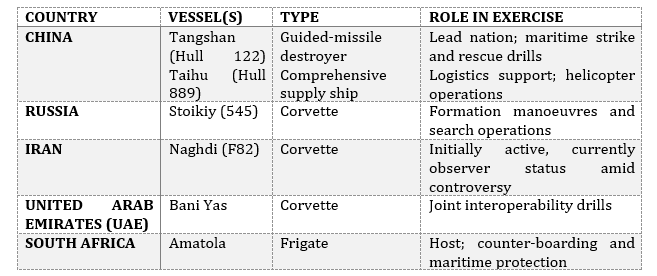
This table summarises key participants based on official reports. Iran’s involvement has been contentious, with initial participation downgraded to observer status due to diplomatic pressures, though the vessel joined sea phases. The South African National Defence Force (SANDF) emphasised knowledge transfer, with senior leaders like Major General Godfrey Thulare conducting briefings.
A timeline of arrivals illustrates the build-up:
- 09 January: Russian corvette Stoikiy arrives in False Bay.
- 09 January: Emirati Gowind corvette Bani Yas photographed arriving.
- 10 January: Opening ceremony at Simon’s Town; Chinese vessels dock.
- 12 January: Iranian vessels enter, sparking debate.
- 13 January: Sea phase commences with five vessels.
- 16 January: Exercise concludes amid ongoing drills.
This coordination demonstrates South Africa’s logistical prowess and commitment to multilateral engagements.
Geopolitical Context
The exercise took place amid intensifying global rivalries. US concerns over BRICS’ “anti-American” policies have led to threats of tariffs and reviews of South Africa’s inclusion in the African Growth and Opportunity Act (AGOA) amid the US House of Representatives’ approval of AGOA’s renewal. Iran’s participation, coinciding with domestic protests and US sanctions, amplified tensions. South Africa defends the drills as essential for maritime security, not a provocation.
From an African neutrality perspective, South Africa maintains a non-aligned stance, echoing its historical anti-imperialist position. This allows engagement with both Western and Eastern powers, as seen in its G20 membership and recent presidency and African Union (AU) advocacy. Critics, including South Africa’s Democratic Alliance (DA), argue it risks economic isolation. However, proponents view it as a counterbalance to Global North dominance, fostering African agency in international affairs.
Economic And Development Dimensions
Economically, “Will For Peace 2026” aligns with BRICS’ focus on South-South cooperation. China, South Africa’s largest trading partner, has invested heavily in African infrastructure, though concerns over debt sustainability persist. The IMF reports that African debt to China stands at around USD 150-billion, with South Africa benefiting from foreign direct investment (FDI) in sectors like mining and renewable energy.
Trade imbalances favour China and Russia, but the exercise promotes maritime safety, crucial for Africa’s USD 300-billion annual seaborne trade. Securing shipping lanes, it supports economic stability, reducing piracy costs estimated at USD 1.5-billion yearly in the Indian Ocean. This ties into AU-G20 synergies, where South Africa pushes for debt relief and sustainable development, emphasising empowerment over dependency.
African Agency In Diplomacy
South Africa’s diplomacy shines through its hosting role, leveraging BRICS to amplify African voices. As a Southern African Developmental Community (SADC) leader, it links the exercise to regional bodies, enhancing maritime domain awareness. The AU’s Agenda 2063 emphasises integrated security, and this drill supports that by fostering interoperability among African and partner navies.
President Cyril Ramaphosa’s administration has navigated pressures, reportedly urging Iran’s observer status to preserve neutrality. This reflects African agency: prioritising continental interests while engaging globally. Youth perspectives, though not central, are relevant in SANDF recruitment drives, where exercises like this inspire careers in defence.
Controversies and Responses
Diplomatic fallout has marred the event. Iran’s initial inclusion risked US reprisals, leading to confusion over its status. Defence Minister Angie Motshekga launched a probe into SANDF’s handling. Critics label it a “diplomatic disaster,” citing minimal military value. South Africa counters that it enhances capabilities without endorsing agendas.
Conclusion
“Will For Peace 2026” exemplifies South Africa’s strategic positioning in a multipolar world, balancing geopolitical tensions with economic opportunities. By centring African agency, it promotes empowerment and neutrality, though challenges remain. As the exercise concludes, its legacy may lie in strengthening South-South ties for a more equitable global order.