Andes Hantavirus Outbreak On Mv Hondius
Andes Hantavirus Outbreak On Mv Hondius: A Test Of Global Health Coordination And Maritime Biosecurity
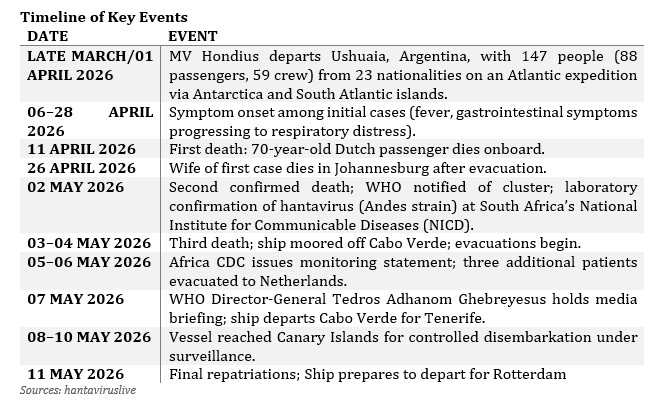
As of 11 May 2026, an outbreak of Andes hantavirus aboard the Dutch-flagged expedition cruise ship MV Hondius has become a multi-country biosecurity incident. The outbreak remains contained following successful controlled disembarkation in Tenerife on 10 May. Eight cases have been linked to the vessel—five laboratory-confirmed and three suspected—with three deaths reported. The fatalities include a Dutch couple and a German national. Additional passengers have been medically evacuated to South Africa, the Netherlands, Switzerland and elsewhere for treatment. Post-disembarkation testing at Tenerife has identified at least two additional positives among repatriated passengers (one asymptomatic US case and one symptomatic French case), bringing totals to approximately ten linked cases with no new deaths. The vessel, with remaining crew, is expected to proceed to Rotterdam, Netherlands, for disinfection.
The incident, which began with likely pre-embarkation exposure in Patagonia, has tested international health regulations, strained port access decisions and highlighted both the vulnerabilities of expedition tourism and the strengths of cross-continental cooperation. While the World Health Organisation (WHO) assesses the global public health risk as low, the event underscores the speed with which rare zoonotic pathogens can generate diplomatic, economic and operational challenges.
Origins and Transmission Profile
Investigations by Argentine authorities and WHO point to pre-embarkation exposure during a four-month overland journey through Chile and Argentina by at least the index cases. As of 11 May, post-disembarkation testing and sequencing (preliminary analysis shows closely related strains consistent with a single zoonotic introduction) have identified additional confirmed cases among repatriated passengers, with no evidence of new transmissions during or after disembarkation. The Andes hantavirus strain, endemic in parts of Patagonia, is carried by the long-tailed pygmy rice rat (Oligoryzomys longicaudatus). Exposure is believed to have occurred via inhalation of aerosolised rodent excreta during outdoor activities such as hiking or birdwatching.
Unlike most hantaviruses, the Andes strain is the only one with documented limited human-to-human transmission, typically requiring prolonged close contact. WHO and partner laboratories (including South Africa’s NICD and Switzerland’s Geneva University Hospitals) have confirmed the strain in cases from the ship. While primary transmission appears land-based, officials continue to examine whether confined shipboard conditions enabled secondary spread. No ongoing transmission among remaining passengers or crew has been reported.
The case-fatality rate for hantavirus pulmonary syndrome in the Americas can reach 40–50% in severe cases, though supportive care improves outcomes. There is no specific antiviral treatment or vaccine.
International Response and Coordination
The response has involved multiple nations under the International Health Regulations (2005). South Africa provided critical laboratory confirmation and intensive care; the Netherlands coordinated repatriations; Spain facilitated controlled disembarkation in the Canary Islands; and the United Kingdom, Switzerland and others have managed contact tracing for disembarked passengers. The US Centres for Disease Control and Prevention (CDC) is monitoring American travellers.
WHO has activated multi-level coordination, shared passenger manifests and supported sample transport to reference labs including Senegal’s Institut Pasteur de Dakar. Contact tracing extends to flights and close contacts. The European and Africa CDCs have intensified surveillance. Spain facilitated highly coordinated, unprecedented-scale disembarkation in Tenerife on 10 May, with passengers transferred by nationality to charter/government flights under biosecurity measures. Contact tracing and 42-day monitoring/quarantine protocols are in place for passengers and close contacts across multiple countries
Geopolitical Context: Tensions And Opportunities
The MV Hondius’s journey has exposed tensions in maritime health governance. Cabo Verde refused docking on biosecurity grounds, citing risks to local populations. Initial opposition from Canary Islands authorities highlighted local-national divides within Spain, with President Fernando Clavijo voicing concerns over consultation and resident safety. Spain’s central government ultimately authorised a controlled approach off Tenerife.
These refusals reflect the balance between sovereign protection of public health and obligations under international law for “free pratique”–the principle that ships should not be unduly delayed. The episode offers opportunities to strengthen protocols for expedition vessels in remote or ecologically sensitive routes, potentially through updated WHO guidance or regional agreements. It also demonstrates effective diplomatic coordination, with no evidence of politicisation beyond standard biosecurity deliberations.
African Agency in the Response
Africa has played a proactive and substantive role despite the outbreak’s South American origin. South Africa’s NICD conducted rapid laboratory confirmation of the Andes strain and provided specialist treatment for evacuated patients, including one remaining in intensive care in Johannesburg. The Africa Centres for Disease Control and Prevention (Africa CDC) issued a formal statement on 05 May 2026, closely monitoring developments, coordinating with affected states and advising member nations to strengthen port health services, infection prevention and timely reporting.
Africa CDC emphasised that the risk to African populations remains low, with no evidence of local transmission, yet stressed vigilance—an approach reflecting growing continental capacity in global health security. Laboratory support extended to Senegal, underscoring intra-African scientific collaboration. This engagement illustrates African agency not merely as a recipient of international aid but as an active contributor to multinational outbreak response, aligning with the continent’s investment in institutions like Africa CDC.
Economic and Development Dimensions
Expedition tourism, valued globally at several billion dollars annually, drives economic activity in remote regions such as Patagonia through local guiding, logistics and conservation-linked enterprises. The MV Hondius incident, however, reveals unpriced risks: potential insurance premium increases, stricter pre-boarding health screenings and reputational damage for operators. Ports refusing docking, such as in Cabo Verde, may face short-term revenue losses from cruise calls, while long-term development of biosecurity infrastructure could become a priority for small island and coastal economies.
Broader development implications include the need for sustainable tourism models that integrate ecological risk assessment, particularly in biodiversity hotspots facing climate-driven changes in rodent populations. Regulators and industry bodies may now accelerate discussions on enhanced environmental impact assessments and health protocols for polar and expedition cruises.
Broader Implications And Ethical Considerations
The outbreak serves as a reminder of the interconnectedness of global travel, remote ecosystems and public health. While the immediate risk remains contained, it raises questions about delayed reporting, passenger notification timelines and adherence to international health obligations on board vessels. Independent reviews of the operator’s response may follow.
Ethically, the response has prioritised verifiable data from WHO, Africa CDC, national health ministries and peer-reviewed laboratory findings, avoiding speculative narratives. This evidence-based approach supports public trust and informed policy. Long-term, the incident could catalyse improved training for expedition staff, rodent-control awareness for travellers and investment in rapid diagnostics for emerging zoonoses.
In summary, the MV Hondius outbreak, has demonstrated the resilience of international health mechanisms while exposing gaps in maritime biosecurity. As the vessel approaches Tenerife and passengers undergo final surveillance, lessons learned could strengthen preparedness for future incidents at the intersection of tourism, ecology and global mobility. Ongoing vigilance by all involved parties will be essential to ensure the risk remains low and that equitable, coordinated responses become the norm.
The WHO has underlined several fundamental differences between the Andes hantavirus and SARS-CoV-2. Hantaviruses, including the Andes strain, are known pathogens that have been studied for decades, in contrast to the novel coronavirus responsible for COVID-19. The Andes hantavirus is not airborne and does not transmit easily, unlike the highly efficient airborne spread observed with COVID-19. Although the case-fatality rate for severe hantavirus pulmonary syndrome can exceed that recorded for COVID-19 in certain cases, the transmissibility of the virus is substantially lower. WHO maintains that the global public health risk associated with this outbreak remains low and that the situation does not constitute the start of an epidemic or pandemic.