Missing The Deadline
Introduction
On 16 September 2026, the Electoral Court dismissed the African National Congress’s attempt to have 181 excluded councillor candidates placed on the ballot for the 04 November local government elections. The judgment depended on whether candidate information captured on the Electoral Commission of South Africa’s (IEC) online system but not completed through the system’s final submission step before 17H00 on 28 August, constituted a valid nomination. The court held that it did not.
The practical effect is more consequential than the technical dispute suggests. In Ngquza Hill and Port St Johns in the Eastern Cape, the ANC will not appear on the ballot at all. In Mangaung, uMshwathi, Walter Sisulu and Sundays River Valley, the party retains some ward candidates but has lost the affected proportional-representation lists. The ANC has said it will appeal, while the IEC is proceeding with the election timetable.
This is not a national electoral collapse as the ANC is still contesting most of the country’s 257 municipalities. Its significance lies in what the episode reveals about the equal application of electoral rules, the organisational capacity of the largest party, and the way delayed internal conflict can be displaced onto a timetable the party does not control. In a local government system already marked by coalition fragility, the consequences extend beyond the six councils.
Capture Is Not Submission
The legal hinge is simple. Parties were required to submit award nominations and proportional-representation lists by 17H00 on 28 August. The IEC’s Online Candidate Nomination System allowed information to be captured, documents to be uploaded and deposits to be paid, but formal nomination required a final confirmation— “Submit as Final”. The ANC completed the earlier steps for the 181 candidates in dispute but did not complete the last one before the cut-off.
The party initially blamed a technical glitch. It later argued that the Municipal Electoral Act and regulations do not expressly require pressing a particular button, and that information already held on the Commission’s system should be treated as submitted. The IEC rejected both propositions, arguing that its server logs showed no downtime, the party had used the same system successfully for most nominations nationwide, and a manual submission route remained available. Its central point was that capturing data was not the same as lodging a list.
The Commission’s answering papers also placed the failure in a wider pattern. Two days before the deadline, the ANC had formally submitted lists for only 18 of 257 municipalities, while activity continued into the final hours of 28 August. The Eastern Cape’s final internal list is reported to have reached the party’s national operation at 16H31, only 29 minutes before the statutory cut-off. The Electoral Court accepted that the nominations had simply not been submitted. The ANC said it would exercise its legal rights and pursue the appeal process.
Where The Vacancies Fall
Nationally, 181 candidates in six municipalities are affected. Locally, however, the exclusions are concentrated in councils where the ANC has historically been the default governing party.
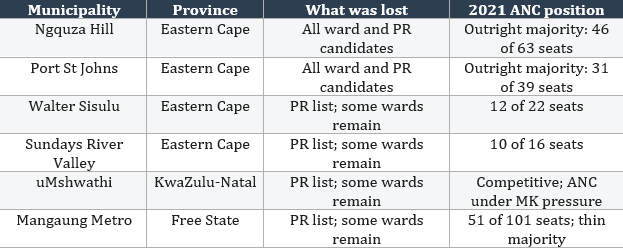
The two complete exclusions are the most unusual. In 2021, the ANC held 46 of 63 seats in Ngquza Hill and 31 of 39 in Port St Johns. Its absence from both ward and PR ballots removes the institutional route through which established local support is converted into council seats.
Mangaung is the strategically important case among the remaining four: the ANC held 51 of 101 seats in 2021, so losing the PR list changes the arithmetic of control even though some ward contests remain. In uMshwathi, Walter Sisulu and Sundays River Valley, the loss of PR candidates similarly reduces the party’s ability to balance ward outcomes through the list.
An Institutional Test, Not A Technical Accident
South African courts have repeatedly required rigid adherence to election deadlines. The Constitutional Court’s Liberal Party judgment in 2004, more recent rulings involving smaller parties, and the Electoral Court’s rejection of the United Democratic Front’s bid to extend the same 28 August cut-off point in the same direction. The IEC has no general power to condone a missed statutory deadline because a party ran out of time. Equal rules are treated as a condition of a free and fair election.
That jurisprudence is why the judgment matters beyond the ANC. Forty-five other parties also had candidates captured on the system but not finally submitted—2,274 names in total, on the Commission’s count. Treating incomplete electronic capture as nomination would have reopened the process for all of them, or raised the question of why it should be reopened for only one. The case therefore tests whether the same procedural standard applies regardless of party size.
The IEC has used the ruling to proceed with the established timetable, including candidate certification and the next ballot-production milestones. For the Commission, certainty over who may contest is an institutional asset: once statutory deadlines become elastic under litigation, each subsequent election milestone becomes more difficult to enforce consistently.
The Party’s Own Delay
The possibility of missing the deadline was not unforeseen inside the organisation. In May 2025, the ANC Electoral Committee chaired by former president Kgalema Motlanthe advised the National Executive Committee to announce mayoral candidates in November 2025 and begin the councillor list process in February 2026. The proposed calendar was intended to leave roughly six months to settle internal disputes before the statutory cut-off—a deadline the party could not move.
The proposal was not adopted. The party began calling for mayoral nominations only in May 2026, while the NEC’s November 2025 candidate-selection guidelines still required lists to be ready at least two weeks before the IEC registration date. Secretary-General Fikile Mbalula later confirmed the reasoning behind the delay, saying the committee “wanted us to start the list processes of councillors by February and to us it was too early because we were going to lose focus on our work when people start to fight about positions.” The internal timetable was eventually compressed further. The extended NEC approved the lists on 25 August and ratified them on 27 August, the day before the deadline.
That was a containment strategy as much as an administrative choice. An early contest over positions would have exposed disappointed members to rival parties for months. The ANC was also trying to prevent internal list fights from eclipsing the campaign. Last-minute intervention continued on 28 August, when, according to Mbalula, ratified lists were subjected to further integrity conditions, including the inclusion of nationally chosen mayoral candidates and the removal of people affected by criminal records, step-aside obligations or pending disciplinary charges. The disputes were not avoided. They were compressed onto a statutory clock, with the result that an internal management problem became an electoral compliance failure.
Second-Order Effects
The first-order effect is representation. In two municipalities the ANC cannot convert residual local support into seats, while in four others its PR strength is impaired. The second-order effects concern how displaced political networks respond when their normal institutional route is removed.
Branches in the affected Eastern Cape municipalities had already protested list disputes before the ruling. The absence of an ANC ballot line in historic strongholds could encourage voter stayaways, independent candidacies where available, or movement to other parties. This should not be inflated into a forecast of violence, it is better understood as a risk that political contestation may relocate outside the structures through which it was previously managed.
A second effect is opportunity for rivals. In OR Tambo, parties such as the EFF and MK have a clearer opening on an ANC-free ballot, although ANC support will not automatically transfer to another party. In uMshwathi, any weakness on the PR ballot occurs in a province where MK has already altered the competitive environment, while Mangaung’s weakened list position has greater significance because council control was already narrow.
The third effect is narrative. The ANC’s public position—that the dispute concerns the legal status of information captured before the deadline, not special treatment—seeks to frame the case as a question of law rather than administrative failure. The counter-narrative is that the largest party missed a deadline that applied to all contestants and then sought recognition of an incomplete process; in a campaign focused on local-government performance, that distinction will remain politically salient.
Outlook
In the short term, the IEC is expected to proceed on the basis of the Electoral Court’s ruling while the ANC’s appeal runs in parallel. The immediate planning assumption for parties, candidates and municipal officials is therefore that the certified lists remain the operative position for the 04 November election unless a higher court intervenes in time.
Over the medium term, the ruling provides a further test of whether electoral administration applies the same statutory limits to the largest party as to smaller contestants. It does not, however, resolve the organisational weakness exposed by the case. The Motlanthe committee identified the vulnerability more than a year ago; the party chose to delay list finalisation in order to postpone internal conflict and limit defections, but the conflict arrived anyway and collided with a deadline the party could not move.
The appeal will determine whether 181 names return to six ballots, but it will not resolve the underlying list-management problem itself. Capture is not submission. Intention is not lodgement. A deadline that can be moved for the largest party is not a deadline. The 2026 local contest therefore carries a narrow but consequential institutional lesson: electoral rules bind the centre as well as the margin, while political organisations still have to finish their own internal processes before the state timetable closes.