Risks on Pretoria Transport Routes
Several suspected tyre-spiking incidents and associated armed robberies reported between 05 and 09 November 2026 have renewed concerns about motorist safety on routes in and around Pretoria. The incidents include a fatal attack on a Russian national travelling towards Kruger National Park and reports of motorists being robbed after sustaining tyre damage on the N4. Although deliberate tyre-spiking has not been conclusively established in each case, the reports highlight the vulnerability of motorists forced to stop on isolated roads after dark.
The incidents have implications for local commuters, tourism operators and commercial transport services using routes connecting Gauteng with Mpumalanga and neighbouring provinces. However, the available information does not establish a measurable increase in attacks or widespread disruption to transport operations. The principal concern remains the recurrence of roadside robberies and the potential for tyre damage to expose motorists to armed assailants.
Recent Reports on the N4 and Surrounding Routes
A warning to motorists travelling eastbound on the N4 towards eMalahleni, near the Kusile off-ramp, followed reports that two vehicles had sustained tyre damage the previous night. Armed suspects reportedly approached the affected motorists and robbed them of personal belongings, including mobile phones. Shots were reportedly fired following the robberies, although no injuries were recorded.
The circumstances raised suspicions that objects had been deliberately placed on the roadway to immobilise vehicles. However, this had not been independently confirmed. Distinguishing between confirmed robbery incidents and the suspected method used to stop vehicles remains important when assessing the threat and identifying appropriate responses.
A separate suspected tyre-spiking incident was reported on the route between Mabopane and Rosslyn on 09 November. The available account provides limited detail about the circumstances or outcome. Nevertheless, the report extends the immediate area of concern beyond the eastbound N4 to routes serving communities and industrial areas north of Pretoria.
Fatal Attack Near Bronkhorstspruit
The reports followed a fatal armed robbery involving two Russian nationals travelling towards Kruger National Park on 05 November. At approximately 22h00, the travellers stopped along the N4 near Ekandustria in the Bronkhorstspruit area after their vehicle sustained tyre damage.
Unidentified assailants subsequently robbed the travellers and fatally shot one. The other sustained an eye injury. The South African Police Service (SAPS) confirmed the incident and opened a murder investigation. Emergency responders indicated that the vehicle had allegedly been targeted through tyre-spiking, although the cause of the tyre damage had not been conclusively established.
The Russian Embassy confirmed the victims’ identities and assisted the surviving spouse. The incident illustrates the potentially severe consequences of an unplanned roadside stop, particularly where motorists have limited access to immediate assistance.
Established Areas of Concern
Suspected tyre-spiking and associated robberies have previously been reported along several major transport corridors in Gauteng and neighbouring provinces. Identified locations include sections of the N4 between Pretoria, Bronkhorstspruit and Balmoral, the N1–N4 interchange, the N4 towards Rustenburg and the Mabopane Highway.
Other previously reported areas include the R21 between OR Tambo International Airport and Pretoria, the R562 near Olifantsfontein, and sections of the N12, N3 and N17. Similar incidents have been reported along the N12 between Klerksdorp and Potchefstroom.
These locations should be understood as reported areas of concern rather than evidence of continuous criminal activity across every listed route. Without comparable incident figures, the reports cannot establish which corridor currently presents the highest risk.
The recurring operational concern is that tyre damage can leave motorists stationary and exposed. Darkness reduces visibility, making obstructions more difficult to identify and limiting motorists’ ability to assess their surroundings before stopping.
Implications for Commuters, Tourism and Freight
The N4 serves domestic travel, tourism and freight movements along the Maputo Corridor. Criminal incidents on this route therefore affect a broad range of road users, including commuters, commercial drivers and visitors travelling towards Mpumalanga’s tourism destinations.
For local motorists, exposure may be difficult to avoid where employment or other essential commitments require night-time travel. Risk reduction consequently depends on practical journey planning and reliable assistance arrangements, alongside policing and road management.
Commercial operators should similarly consider the implications of unplanned roadside stops when reviewing driver communication and assistance procedures. Nevertheless, the reported incidents do not demonstrate widespread freight disruption. Their immediate significance lies in the threat to individual drivers and passengers, with possible delays and additional security requirements following an incident.
Travel Precautions and Response
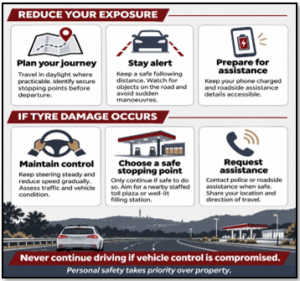
Motorists are advised to minimise unnecessary night-time travel on affected routes where practicable. While travelling, drivers should maintain appropriate following distances and remain alert to unusual objects or obstructions. Any response must account for surrounding traffic and road conditions, as abrupt manoeuvres can introduce additional hazards.
If tyre damage occurs, the immediate priority is maintaining control of the vehicle. Where vehicle condition and road circumstances permit, motorists are further advised to avoid stopping in an isolated location and proceed cautiously to a nearby staffed toll plaza, well-lit filling station or another secure location. This should not be interpreted as advice to continue driving when doing so would compromise control.
Outlook
The recent reports indicate a continuing roadside security concern around Pretoria, particularly after dark. Confirmation of the mechanism used in individual incidents will remain important to understanding the threat accurately.
The Tshwane Metropolitan Police Department has previously increased freeway patrols in response to reported attacks. Sustained law enforcement visibility, targeted patrols and timely reporting remain relevant measures, supported by attention to lighting and roadway hazards.
As holiday travel increases, practical communication between authorities, road operators and transport businesses will be important. Motorists should receive clear information that supports informed travel decisions while distinguishing confirmed incidents from unverified reports.