The Board Of Peace: A New Global Initiative And South Africa’s Notable Absence
Introduction
The establishment of the Board of Peace in January 2026 marks a significant shift in international diplomacy, particularly in efforts to resolve conflicts like the Israel-Hamas war in Gaza. Initiated by the United States (US) under President Donald Trump, this body aims to oversee reconstruction, governance, and broader global stability. However, its formation has sparked debates about its potential to rival the United Nations (UN) and reinforce US influence. From an African perspective, South Africa’s exclusion from this initiative underscores tensions in Pretoria’s foreign policy, highlighting the continent’s push for agency amid great-power rivalries. This article examines the Board’s membership, South Africa’s omission, and broader implications through an Africa-centric lens, emphasising empowerment and regional priorities over external dependencies.
Origins And Objectives Of The Board Of Peace
The Board of Peace emerged from President Trump’s Gaza peace plan and was initially proposed by former UK Prime Minister Tony Blair in August 2025. The Board was announced alongside the Gaza peace plan by President Trump in September 2025 followed by a partial acceptance by Israel and Hamas in October. Endorsed by UN Security Council Resolution 2803 in November 2025, it was formally established on 22 January 2026, during the World Economic Forum in Davos, Switzerland. President Trump, who chairs the Board for life, signed the charter alongside representatives from about 20 founding members.
Initially focused on Gaza’s demilitarisation, reconstruction, and transitional governance under the National Committee for the Administration of Gaza (NCAG), the Board’s charter suggests a wider mandate for global conflict resolution. Critics argue this could undermine the UN, with permanent membership requiring a USD 1-billion contribution—3-year terms remain with no mandatory fees. The structure includes an executive council with figures like US Secretary of State Marco Rubio, former Senior Advisor to the President of the United States Jared Kushner, and Blair.
From Africa’s viewpoint, the Board’s Gaza-centric origins resonate with continental concerns over the Palestinian conflict, yet its US-led nature raises questions about inclusivity. African nations like Egypt and Morocco, key in regional diplomacy, have joined, but the initiative’s top-down approach may sideline African-led solutions through bodies like the African Union (AU).
Invited Members: Acceptances, Rejections, And Us Ties
The Board has attracted a diverse but selective membership, with President Trump claiming 59 signatories, though only about 20 attended the Davos ceremony. Invitations went to around 60 countries, focusing on those aligned with US interests or willing to contribute to Gaza’s stabilisation.
Many acceptances come from US allies or nations with strategic ties, such as Middle Eastern states (UAE, Saudi Arabia, Bahrain, Qatar, Jordan, Egypt) and others like Hungary, Argentina, Türkiye, Pakistan, and Vietnam. These countries often have strong economic or security relations with Washington; for instance, the UAE’s involvement aligns with its role in the Abraham Accords normalisation with Israel.
Rejections highlight European concerns over the Board’s potential to erode UN authority. France, Norway, Sweden, Slovenia, Germany, Italy, and the UK declined, citing risks to multilateralism, with the UK also expressing concerns over Russian President Vladimir Putin’s potential involvement. China and Russia remain noncommittal, studying details amid broader US rivalries. Canada had accepted in principle, but saw its invitation withdrawn by President Trump.
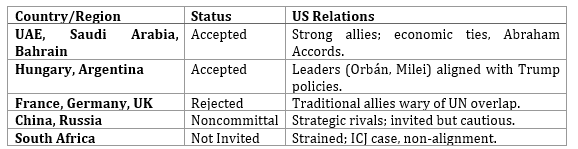
This membership skews towards US-friendly states, reflecting Washington’s dominance in the initiative. It should be noted, however, that some of the countries that accepted invitation to the Board’s Council did so mainly due to being stakeholders in the Gaza conflict.
South Africa’s Exclusion: Key Factors And Concerns
South Africa was notably not invited to the Board, a decision rooted in escalating US-SA tensions. Pretoria’s International Court of Justice (ICJ) genocide case against Israel, filed in December 2023 and ongoing in 2026, has been a flashpoint. The US, Israel’s close ally, views this as adversarial, especially after the ICJ’s January 2024 order for Israel to prevent genocidal acts. South Africa’s stance aligns with its historical solidarity against apartheid-like policies, but it has drawn US ire, including aid cuts and ambassador expulsion in 2025.
Non-alignment further complicates relations. South Africa’s policy of neutrality, evident in abstentions on UN votes condemning Russia’s Ukraine invasion, has led to perceptions of anti-US bias. Recent military exercises with Russia, China, and Iran in January 2026—despite US warnings—underscore this. These drills, involving BRICS partners, were criticised as undermining neutrality.
Domestic issues like land expropriation, seen by President Trump as “anti-white,” exacerbate exclusion. From an African lens, this reflects how Global North powers penalise principled stances, pushing the continent towards self-reliance.
South Africa-Us Relations: A Strained Partnership
Bilateral ties hit a low in 2026, with President Trump barring South Africa from the 2026 G20 and halting subsidies over alleged Afrikaner persecution—a claim Pretoria dismisses as misinformation. This was followed by the US’s appointment of L Brent Bozell as Ambassador to South Africa. Tariffs of 30% on non-mineral imports and AGOA’s lapse in 2025—its confirmed renewal by the US House of Representatives and South Africa’s ambiguous inclusion status—compound economic pressures. US FDI in South Africa stands at USD 7-90-billion, supporting sectors like renewables, but tensions risk outflows.
South Africa’s non-alignment, rooted in anti-imperialism, clashes with US expectations. Yet, Pretoria maintains African agency, advocating neutrality in US-Russia/China rivalries.
Economic And Development Dimensions
US-SA trade imbalances persist, with South Africa exporting USD 20-billion to the US (minerals exempt from tariffs) but facing a USD 8.8-billion surplus scrutiny. FDI flows to Africa surged to USD 65-billion in 2024, driven by diversification, but debt sustainability remains a concern amid global shocks. South Africa’s exclusion highlights vulnerabilities, pushing South-South cooperation via BRICS for trade and debt relief.
Geopolitical Context: African Neutrality Amid Rivalries
US-Russia/China tensions frame South Africa’s exclusion, with Pretoria’s exercises seen as aligning with adversaries. Africa leverages neutrality for opportunities, avoiding full alignment in a multipolar world. The Board’s US-centric logo and exclusion of major powers like China underscore this divide.
African Agency: South Africa’s Diplomatic Role
South Africa exemplified agency through its 2025 G20 presidency, advancing solidarity, equality, and sustainability—hosting the first African summit and pushing AU integration. Synergies with the Southern African Developmental Community (SADC) and AU amplify continental voices, as seen in pre-G20 consultations. Despite exclusion, South Africa’s ICJ case affirms its commitment to global justice, countering Global North dominance.
Conclusion: Empowerment Over Dependency
The Board of Peace, while innovative, risks entrenching US hegemony, as evidenced by South Africa’s exclusion amid principled stances on Palestine and non-alignment. For Africa, this highlights the need for self-empowerment through AU-G20 synergies and South-South ties, fostering resilience against external pressures. South Africa’s diplomacy, centred on continental priorities, offers a pathway to balanced global engagement.