US-SA Relations: An African Perspective
Introduction
The handover of the G20 presidency from South Africa (SA) to the United States (US) on 28 November 2025 has spotlighted longstanding tensions between the two nations, exacerbated by the US’s repeated allegations of ‘white genocide’ and illegal land grabs in South Africa. These claims, amplified by US President Donald Trump and echoed in a recent statement by Secretary of State Marco Rubio, have strained bilateral ties at a critical juncture in global multilateralism. From an African viewpoint, this discord not only underscores the challenges of Global South representation but also highlights South Africa’s role in championing equity and solidarity amid geopolitical shifts.
Building on our last series—beginning with “G20 Foundations and South Africa’s Presidency”, “Pre-Summit Momentum – Insights from Engagement Groups”, and “Summit Reflections – Outcomes, Handover, and Africa’s Path Forward”—this article examines the dynamics of US-SA relations through an Africa-centric lens. It analyses the historical context, recent exchanges, and geopolitical implications, while linking to broader African initiatives like Agenda 2063 and the African Continental Free Trade Area (AfCFTA). With a focus on economic dimensions, African agency, and future scenarios, the piece draws on official sources to foster informed discourse on Africa’s evolving global role.
Secretary Rubio And Minister Lamola
The latest flashpoint emerged on 03 December 2025, when US Secretary of State Marco Rubio published a Substack post outlining the US’s vision for its 2026 G20 presidency while sharply criticising South Africa’s tenure. Secretary Rubio accused the African National Congress (ANC)-led government of promoting ‘redistributionist policies’ driven by ‘racial grievance’, leading to economic stagnation, corruption, and violence against Afrikaner citizens. He reiterated US claims of ‘racism and tolerance for violence’, including ‘land confiscation without compensation’, and announced that South Africa would not be invited to the 2026 Miami Summit, citing ‘spite, division, and radical agendas’ during Johannesburg’s hosting.
In response, South African Minister of International Relations and Cooperation Ronald Lamola issued a measured rebuttal on 05 December 2025. Minister Lamola congratulated the US on its presidency but defended South Africa’s democratic journey, emphasising its Government of National Unity (GNU, comprising ten parties) and constitutional mandate for redress against apartheid’s legacies. Invoking Nelson Mandela’s vision of reconciliation intertwined with redistribution, he refuted allegations of racism, highlighting economic growth since 1994—GDP doubling from ZAR 3.6-trillion to ZAR 7.3-trillion (in constant 2023 prices)—and agricultural exports reaching nearly USD 14-billion in 2024. Minister Lamola stressed Ubuntu philosophy, noting global praise for South Africa’s ‘people’s G20’, including comments from leaders like India’s Narendra Modi and IMF Managing Director Kristalina Georgieva.
This exchange, rooted in divergent interpretations of justice and governance, reflects broader ideological clashes: the US’s ‘America First’ emphasis on deregulation versus South Africa’s focus on equity and multilateralism.
History Of Bilateral Relations
US-SA relations trace back to the 18th century, with early trade ties evolving into complex diplomatic engagements. Post-World War II, the US initially supported South Africa’s anti-communist stance during the Cold War, providing economic aid and overlooking apartheid until international pressure mounted. The 1970s-1980s saw a shift: US civil rights movements and anti-apartheid activism led to sanctions under the Comprehensive Anti-Apartheid Act of 1986, overriding President Ronald Reagan’s veto. This isolation contributed to apartheid’s end in 1994.
The post-apartheid era ushered in warmer ties. Under Presidents Bill Clinton and Nelson Mandela, the US-South Africa Binational Commission (1994) fostered cooperation in trade, health, and education. The African Growth and Opportunity Act (AGOA, 2000) boosted South African exports to the US, reaching USD 11.8-billion by 2024, per US Trade Representative data. However, tensions arose over issues like South Africa’s neutral foreign policy—e.g., its abstention on UN votes condemning Russia’s 2022 Ukraine invasion—and trade disputes, including US tariffs on South African steel in 2018.
Recent strains intensified under President Donald Trump’s first term (2017-2021), with his 2018 tweet alleging ‘large scale killing of farmers’ in South Africa, based on unsubstantiated claims from far-right sources. Fact-checks by organisations like Africa Check and Human Rights Watch have debunked ‘white genocide’ narratives, noting farm murders (averaging 50-60 annually) occur amid broader crime rates affecting all groups. Land reform, aimed at addressing apartheid-era dispossessions where 72% of farmland remains white-owned (per South African government audits), proceeds via market-based expropriation with compensation, as affirmed by the World Bank.
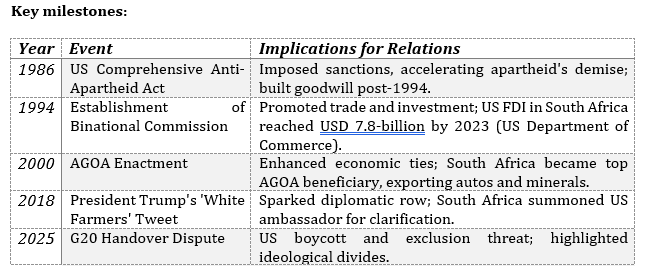
This timeline illustrates a trajectory from confrontation to cooperation, now reverting to friction amid global realignments.
Key Tensions: Allegations Of White Genocide And Land Grabs
US allegations of ‘white genocide’—a term popularised by fringe groups and amplified by President Trump—stem from reports of farm attacks, which South African authorities attribute to criminality rather than racial targeting. Official statistics from AgriSA (2024) show a decline in farm murders from 74 in 2017 to 52 in 2023, with perpetrators often motivated by robbery. Human Rights Watch (2023 report) confirms no evidence of state-sanctioned genocide, emphasising instead the need for rural security reforms.
Land grabs refer to Section 25 of South Africa’s Constitution, allowing expropriation without compensation in limited cases for public interest. However, implementation has been slow and compensation-based: since 1994, only 10% of farmland has been redistributed, per the Department of Agriculture, Land Reform and Rural Development. Critics, including Secretary Rubio frame this as discriminatory, ignoring apartheid’s forced removals displacing millions of black South Africans. From an African perspective, these reforms align with Agenda 2063’s goal of equitable resource access, fostering sustainable development and reducing inequality.
The G20 Handover Controversy
As detailed in Article 3 of the G20 series, the Johannesburg Summit’s handover was unconventional: absent US high-level representation due to the boycott, DIRCO representatives handed instruments to a junior US official post-summit. Secretary Rubio’s post formalised exclusion, condemning South Africa’s agenda on climate, diversity, and aid as ‘radical’. Minster Lamola countered by affirming South Africa’s founding G20 status and rejecting unilateral exclusion, per G20 principles.
This episode exposes multilateral vulnerabilities, with South Africa leveraging AU-G20 synergies to maintain Global South priorities like debt sustainability.
US-SA Relations
Current relations are at a low ebb, characterised by mutual distrust. Economically, the US is South Africa’s second-largest trade partner (USD 20.6-billion bilateral trade in 2023, per IMF), but disputes contributed to the expiration of AGOA without renewal in September 2025. Politically, South Africa’s BRICS alignment and ICJ case against Israel (2024) clash with US positions.
Future scenarios for 2026:
- Escalation: The US’s exclusion of South Africa from the 2026 G20 could prompt South African retaliation, e.g., via AU or BRICS, straining trade. Debt negotiations might falter, impacting Africa’s USD 1.2-trillion debt burden (World Bank, 2024).
- De-escalation: Backchannel diplomacy, perhaps via shared interests in counterterrorism or health (e.g., PEPFAR’s USD 7-billion aid to South Africa since 2003), could restore ties. Efforts to revive AGOA-like preferences might serve as a bridge.
- Status Quo: Parallel tracks—economic cooperation amid political friction—persist, with South Africa pivoting to China (trade volume: USD 54-billion in 2023).
African neutrality in US-China rivalry positions South Africa to mediate, enhancing its diplomatic leverage.
Geopolitical Implications Of This Tension
The US-SA rift reverberates globally, undermining G20 cohesion amid polycrises like climate change and inequality. For the world, it signals eroding multilateralism: US unilateralism could fragment forums, benefiting rivals like China, which invested USD 25-billion in African infrastructure in 2024 (per African Development Bank). Implications include stalled climate finance—Africa needs USD 180-250-billion annually for adaptation (Intergovernmental Panel on Climate Change [IPCC], 2023)—and heightened South-South cooperation, as seen in AfCFTA’s projected 52% intra-African trade boost by 2040 (World Bank).
From an African lens, this tension bolsters calls for sovereignty, linking to Agenda 2063’s vision of a self-reliant continent. It exposes Global North dominance, prompting AU reforms for stronger representation.
Economic And Development Dimensions
Trade imbalances persist: South Africa exports minerals to the US but faces tariffs, while FDI flows (USD 2.3-billion in 2024) are overshadowed by corruption perceptions. Debt sustainability is key—South Africa’s USD 88-billion external debt (2024, IMF)—with US-SA tensions risking creditor coordination. AfCFTA integration offers resilience, potentially adding USD 450-billion to Africa’s GDP by 2035 (AfDB), through South-South ties.
African Agency: Spotlight On South Africa’s Diplomacy
South Africa’s G20 leadership exemplified African agency, centring AU priorities and gender/youth perspectives (e.g., women’s empowerment groups). SADC endorsements and BRICS alliances counter US pressures, fostering neutrality in global rivalries.
Conclusion
US-SA tensions, from white genocide allegations to G20 exclusion, highlight ideological divides but also Africa’s rising voice. By linking to AfCFTA and Agenda 2063, South Africa advances Global South empowerment, urging equitable multilateralism. As 2026 unfolds, dialogue remains essential for shared prosperity, transcending grievances toward solidarity.